

Lots of big (mostly bad) things happened in October, including:
Amazon and Alphabet reported, respectively, $9 billion and $42 billion of negative free cash flow, as AI hit a financial wall:
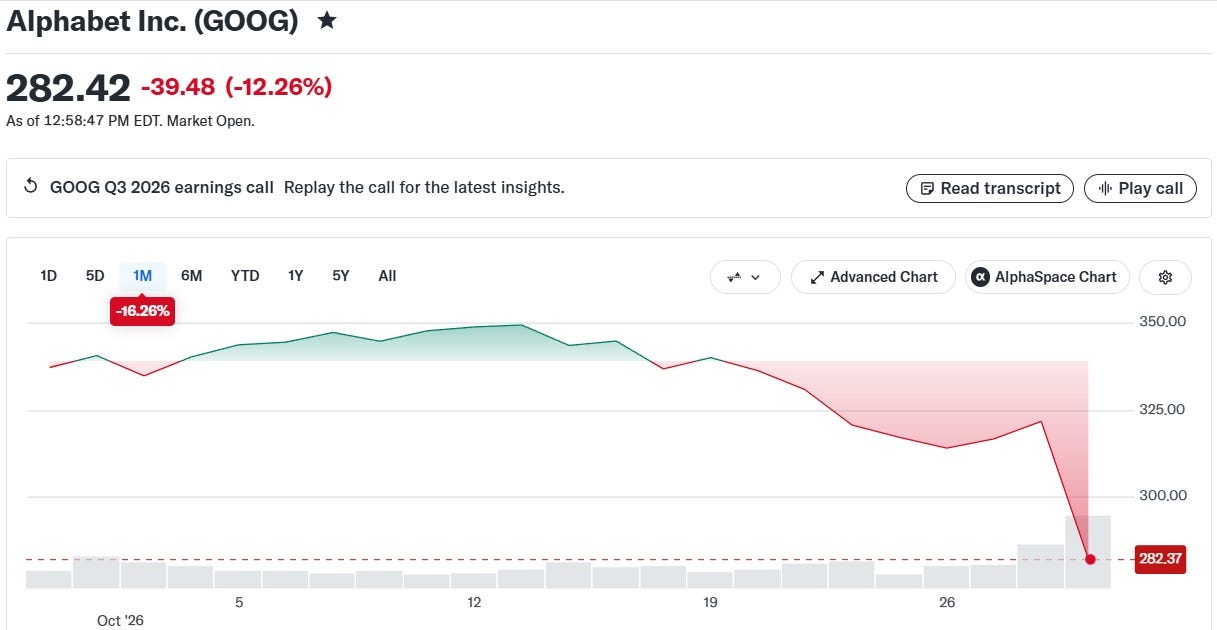
Housing rolled over as inventory spiked and buying plunged
Gasoline prices rose by 9%, sending inflation up at an annualized 6% rate
France —and several of its neighbors — descended into chaos as riots spun out of control
A major crypto platform was hacked, calling the safety of stablecoins into question:
The $6.3 Billion Binance Hack
(HealthRanger) - The world’s largest cryptocurrency exchange just suffered what may be the single largest heist in financial history. Early reports point to a staggering $6.3 billion in losses, and the fallout is still being tallied.
Binance insists it will “cover all losses” and that user funds are safe. The self-insurance works this time only because the stolen sum, however colossal, represents less than 5% of the exchange’s total assets. That is the entire game: you are protected not by your own security, but by the exchange’s balance sheet being large enough to absorb a catastrophic loss. If the next hack is bigger, or if the exchange’s assets shrink, that guarantee may not be as strong.
I have watched this movie before. BlockFi froze client withdrawals the moment FTX collapsed [3]. Bitmart suspended withdrawals after hackers stole $196 million [4]. Each time, the lesson is identical: centralized crypto custody is not ownership. It is a promise that can be broken overnight. I believe this Binance event is the final warning that digital asset storage must be rethought from the ground up.
Whew
October, in short, was a brutal month ending with a singularly bad day for commodities stocks. Now the question becomes: Was this a sharp but temporary correction or the end of the commodities bull market?
For perspective, ask yourself the following questions:
Will governments keep living beyond their means and borrowing the difference?
Will the interest on this mountain of debt keep rising?
Will the only solution be to inflate away that debt?
Will other crypto exchanges be hacked going forward?
If you answered “yes” to these questions, then the underlying fundamentals remain positive for physical assets in general and precious metals in particular:
If You Don’t Have Self-Custody, You Don’t Own It
(HealthRanger) - When you leave crypto on an exchange, you do not control your assets -- the exchange does. As I have explained in my own broadcasts, the entire point of peer-to-peer technology is to eliminate the trusted intermediary; atomic swaps, for instance, allow cross-chain trading “wallet to wallet, without a trusted intermediary like an exchange” [5]. The moment you deposit your coins into a custodial exchange, you have rebuilt the very middleman that decentralized money was designed to remove. You hold a database entry, not a key.
And the threat landscape is accelerating beyond human defenders. AI-enabled cyber attacks are making exchanges increasingly vulnerable, because malicious code can be generated and deployed at scale -- far faster than security teams can patch. The data race to amass digital information has not escaped the notice of attackers looking to profit by hacking into that data [6]. An exchange is a single, enormous honeypot, and now the attackers have machine-speed tools. I believe the age of trusting a centralized exchange with meaningful wealth is over.
Physical gold and silver are different in kind, not just in degree. Gold and silver have no counterparty. No server can be drained, no wallet can be compromised, no login can be phished. A gold coin in your hand cannot be digitally stolen because it does not exist as data. The great virtue of precious metals is that they are money you can hold, verify, and hide -- honest money with no permission layer. In a world where billions can vanish from a website in a single night, that physical reality is not nostalgia. It is a security architecture.
Portfolio
Volatility creates opportunities. So view October’s carnage as our favorite assets going on sale, and respond with low-ball bids on high-quality commodity stocks.