

Lots of people believe some sort of “currency reset” is coming. But few understand the details.
Macro Butler’s Laurent Lequeu just solved that problem with a great post on what a currency reset is, why it’s imminent, and how it might be implemented. Here’s an excerpt:
Reset in Peace?
October 31, 2026

Every fiat currency is a promise. Every promise has an expiry date. History has never once failed to collect.
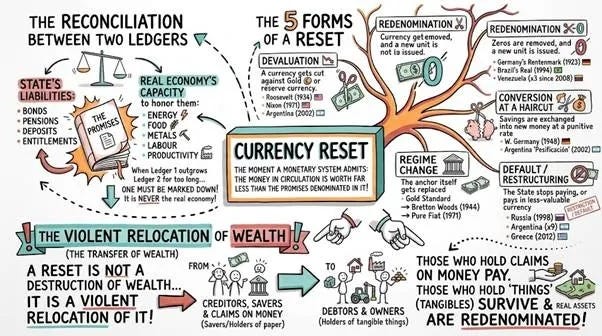
A currency reset is the moment a monetary system is forced to admit what markets already know: the money in circulation is worth far less than the promises denominated in it.
It is the accounting reconciliation between two ledgers. On one side sit the state’s liabilities: bonds, pensions, deposits, entitlements. On the other side sits the real economy’s capacity to honour them: energy, food, metals, labour, productivity. When the first ledger outgrows the second for long enough, one of them must be marked down. It is never the real economy.
A reset can take several forms, often in combination:
Devaluation. The currency is cut against gold or a reserve currency. Roosevelt in 1934, Nixon in 1971, Argentina in 2002.
Redenomination. Zeros are removed and a new unit is issued. Germany’s Rentenmark in 1923, Brazil’s Real in 1994, Venezuela three times since 2008.
Conversion at a haircut. Savings are exchanged into the new money at a punitive rate. West Germany in 1948, Argentina’s “pesificación” in 2002.
Regime change. The anchor itself is replaced. Gold standard to Bretton Woods in 1944; Bretton Woods to pure fiat in 1971.
Default or restructuring. The state simply stops paying or pays in a currency worth less. Russia 1998, Argentina nine times, Greece 2012.
The common thread is a transfer of wealth. Those who hold claims on money pay. Those who hold things are redenominated and survive. A reset is not a destruction of wealth so much as a violent relocation of it, from creditors to debtors and from savers to owners.
The second common thread is denial. No finance minister has ever announced a reset in advance. The pattern is always the same: “There will be no devaluation,” followed by a long weekend.

Currency resets are not rare accidents. They are the normal ending of fiat experiments, and history offers a long, repetitive catalogue. The table below lists the major episodes, the mechanism used and the trigger behind it.
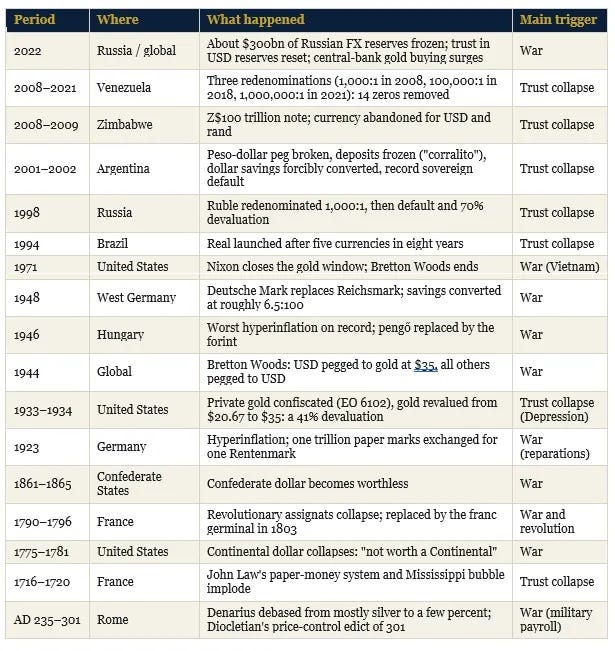
Read the table from the bottom up and a pattern emerges. Rome clipped coins to pay legions. France printed assignats to fight Europe. America printed Continentals, then Greenbacks, then broke from gold twice. Germany printed to pay reparations, then rebuilt on a new mark. The monetary unit changes, the costume changes, the plot never does.
Three observations matter for investors:
Read the rest of Laurent’s post here.
Subscribe to Macro Butler here.
The inevitable end of fiat debt.
None of those resets are on the immediate horizon. Inevitable does not mean imminent. I guess you could argue yield curve control is restructuring, but it doesn't say that. I need to see big attempts at YCC and/or more QE fail before I start thinking there will be a reset. If we were anywhere near a reset I think gold would be headed up, not down. And gold should be heading up when they really start doing YCC or more QE. I am waiting for that but I don't see it yet.
The debt to GDP is about 100%(not including interagency debt which I view as accounting details and demand for more spending but not real debt) and increasing between 1-2% per year. It could be awhile before a financial crisis that would drive those actions. Maybe less if the AI stock bubble crashes and burns causing recession, etc. Or Bessant could could start buying 10s or 100s of billions of long term treasuries the day after the mid term elections.
Being prepared for the precursors of a reset(YCC, more QE, others?) should be nearly the same as being prepared for a reset so perhaps inevitable does not mean imminent is semantics.